
Something small and brown darts across your yard, or strange trails appear in your lawn after the snow melts. Either way, you’ve got a question that’s surprisingly tricky to answer: is it a mouse or a vole? The two look similar at first glance, but they live very different lives, cause very different damage, and need very different solutions. At Gilles Lambert Pest Control, we help Winnipeg homeowners answer this question all the time. Here’s exactly how to tell these pests apart so you can take the right next step.
In This Guide
Physical Differences Between Mice And Voles
Where Each Pest Lives And Hides
Damage Signs: How To Tell If You Have Mice Or Voles
How To Control Mice And Voles On Your Property
Gilles Lambert Pest Control Can Solve Your Mouse Or Vole Problem
Frequently Asked Questions About Mice And Voles
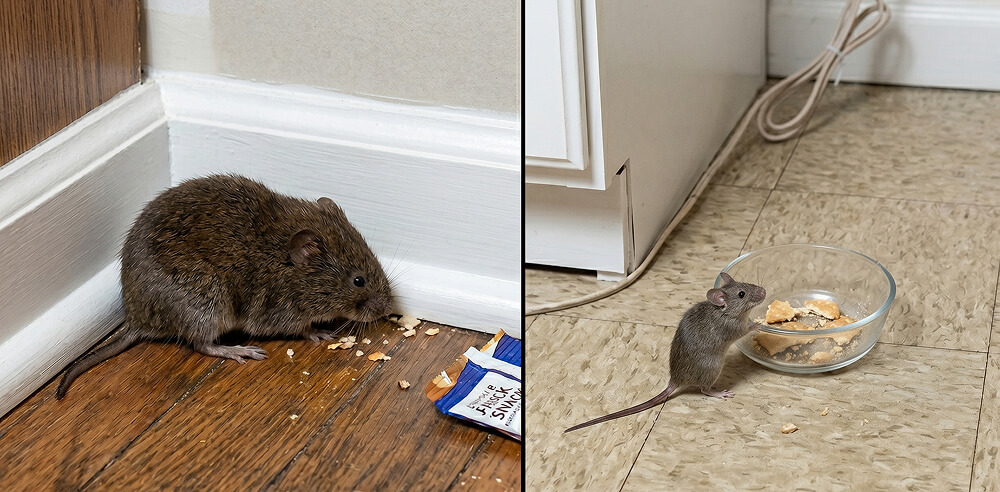
The fastest way to tell a mouse from a vole is to look at the tail. Mice have long, slender, hairless tails usually as long as their bodies, measuring two and a half to six inches. Voles have short, stubby, hairy tails about one to two inches long. Tracks and footprints on dusty surfaces also indicate mice, since their light, four-toed front prints are distinct from vole tracks.
After the tail, check the ears and face. Mice have big, rounded ears, large eyes, and pointed snouts. They’re slender and upright, built for climbing and squeezing through small gaps. Voles are stout and plump with tiny ears partly hidden in their fur and blunt, hamster-like faces.
The house mouse (Mus musculus) is the most common indoor invader, while the meadow vole (Microtus pennsylvanicus) causes most lawn damage. You might also encounter the deer mouse (Peromyscus maniculatus), especially in rural areas and cottages. Deer mice have white bellies and bi-coloured tails, which sets them apart from house mice.
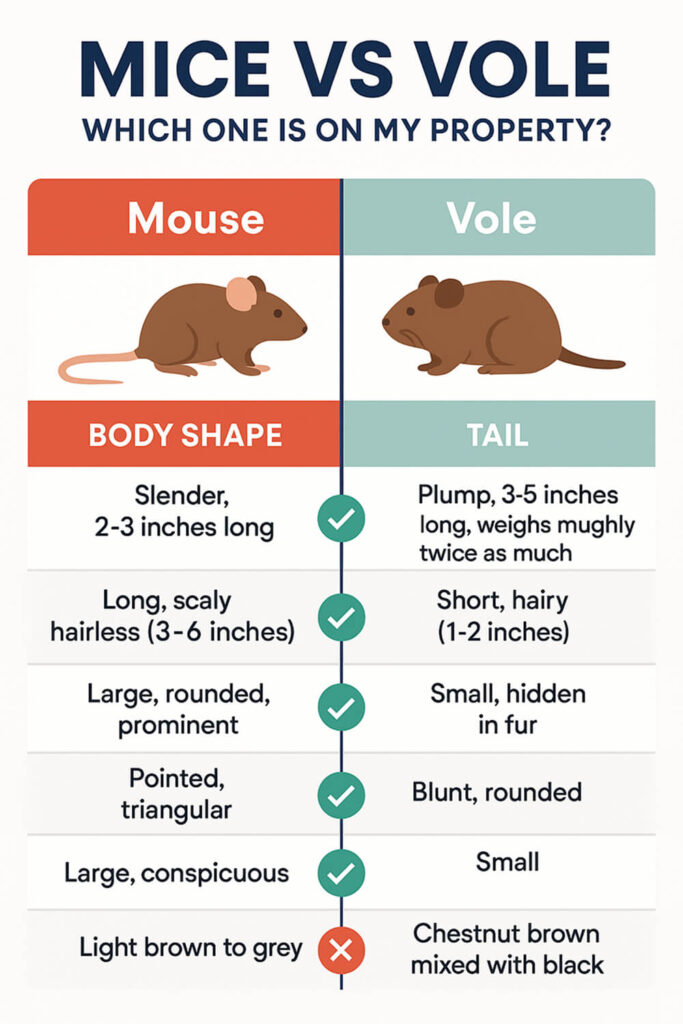
| Feature | Mouse | Vole |
| Body shape | Slender, 2-3 inches long | Plump, 3-5 inches long, weighs roughly twice as much |
| Tail | Long, scaly, hairless (3-6 inches) | Short, hairy (1-2 inches) |
| Ears | Large, rounded, prominent | Small, hidden in fur |
| Snout | Pointed, triangular | Blunt, rounded |
| Eyes | Large, conspicuous | Small |
| Fur colour | Light brown to grey | Chestnut brown mixed with black |
Both mice and voles are active year-round, so you won’t rule one out based on the season. If you’ve seen something larger with a thicker tail, our guide on identifying mice versus rats covers those differences. And if you’re spotting wildlife but aren’t sure whether it’s a rodent at all, backyard squirrel identification can help narrow things down. Shrews are another lookalike, but they’re insectivores with extremely pointed snouts, tiny eyes, and five toes on their front feet instead of four.
Where you spot the animal tells you almost as much as what it looks like. Mice and voles occupy completely different parts of your property.
House mice have adapted to live alongside people. They actively seek indoor shelter, especially during Manitoba’s fall temperature drop from September through November. Mice cause damage through incessant chewing and nest-making, and you’ll find them in attics, basements, wall voids, and kitchen cabinets. Deer mice are especially common in rural Manitoba, moving into houses, outbuildings, cottages, and even idle farm machinery. If you hear scratching in your walls and ceilings, or find papery nests behind appliances, you’re dealing with mice.
Voles almost never come inside. Meadow voles live above ground in your yard, while pine voles create burrow entry points just below the soil surface. Both prefer dense plants, tall grass, and mulched gardens. The telltale sign is surface runways: narrow pathways of dead grass about two inches wide that become visible when snow melts or when you lift matted grass. Don’t confuse these with rat runs, which are paths worn by rats and tend to be wider. You’ll find vole droppings and clipped vegetation along these trails.
A simple way to think about it:
Moles have paddle-shaped feet with prominent digging claws and eat insects rather than plants. They’re an entirely separate animal. Correct identification is always the essential first step toward effective control.
You don’t always see the pest itself. More commonly, you see what it left behind. The damage patterns are so different that you can usually diagnose the problem without spotting the animal.
Mouse damage shows up indoors. Mice prefer warm areas near food like kitchens, pantries, and storage rooms. They gnaw on anything: look for chewed wires, damaged food packaging, and shredded paper or fabric used as nesting material near appliances. Mouse droppings are dark, pointed at both ends, and about three to six millimetres long, roughly the size of a grain of rice. You’ll find them along walls and floorboards, tracing pathways between nests and food sources. Grease marks along baseboards are another classic sign. Mice contaminate food with urine and droppings, increasing the risk of hantavirus, salmonella, and food poisoning. If you find droppings in your kitchen, wet them with a bleach solution before cleaning and avoid sweeping, which can spread the germs.
Vole damage shows up outdoors. The most obvious sign is vole runways in your grass, one to two inches wide, with short-clipped plants along the edges. Vole droppings look similar in size to mouse droppings but tend to have a greenish tinge from their plant-heavy diet, and you’ll find them clustered along runway paths rather than scattered indoors. In garden beds, you’ll find damaged bulbs and root systems. On young trees and shrubs, look for gnaw marks and stripped bark at the soil line with visible quarter-inch tooth marks. This bark stripping, called girdling damage, can kill a young tree by cutting off its nutrient flow. Pine voles can destroy root systems entirely, and meadow vole damage typically concentrates at the base of fruit trees. Voles can also carry tularemia and can harbour ticks that transmit Lyme disease.
The key question is simple: is the damage inside or outside? Mice don’t destroy turf grass. Voles don’t chew your wires. Our article on spring mouse and vole control covers what to watch for as winter damage becomes visible.
Correct identification is essential before starting any control program, because mice and voles need completely different approaches.
Mouse control focuses on three things: sealing entry points, cleaning up food sources, and indoor treatments.
1. Seal entry points. Mice can squeeze through gaps as small as a quarter inch. Fill those gaps with steel wool and metal flashing. These exclusion methods are the foundation of lasting control.
2. Remove attractants. Mice prefer grains, fruits, seeds, and high-carbohydrate foods, but when food is scarce, they’ll eat insects, meat scraps, and even soap or glue. Store all food in sealed containers, eliminate clutter that provides nesting spots, and fix leaks that offer a water source.
3. Treat strategically. Snap traps placed along walls and baseboards work for small populations. For larger infestations, rodent bait stations could be used. It is important to note that treatments should be kept away from pets and children.
Overgrown trees and bushes can help mice access your roof, so trim vegetation back from your home. Our detailed guide on how to mouse-proof homes walks you through the full process. You can also follow our mouse-proofing prevention tips for a step-by-step checklist.
Vole control focuses on habitat modification. Voles need cover to feel secure, so removing that cover is the most effective strategy.
1. Reduce ground cover. Keep grass cut to three inches or less and clear brush piles and leaf piles near your foundation.
2. Protect trees and shrubs. Install quarter-inch hardware cloth guards around trunks to prevent girdling. Remove thick mulch within twelve inches of tree bases.
3. Monitor and target. Snap traps placed at right angles across active runways work for small populations. Outdoor bait stations designed for indoor mice aren’t effective against voles, so proper placement matters.
At Gilles Lambert Pest Control, we use an integrated pest management approach combining habitat changes, exclusion, and targeted treatments. A breeding pair of mice can produce over fifty offspring in a single year, and vole populations can reach over a thousand per acre in boom years. Simply having a cat or dog isn’t enough to control an established population. Cats catch individual mice, but they won’t keep up with a colony breeding inside your walls. Dogs may chase voles in the yard, but they can’t reach the ones tunnelling beneath the snow.
Seasonal timing matters, too. Voles do their worst damage under snow cover from October through April, chewing bark and roots in surface tunnels you can’t see until spring. Mice push hardest to get indoors from September through November as temperatures drop.
Whether you’ve found droppings in your kitchen or trails in your lawn, the difference between a vole and a mouse determines whether you need indoor pest control or landscape management. Getting that answer wrong means wasted effort and a problem that keeps growing.
At GL Pest Control, we’ve built our reputation on getting the identification right the first time. We’ll inspect your property, confirm which pest you’re dealing with, and build a treatment plan that matches your needs. For mice, that means sealing entry points, removing attractants, and placing treatments where they’ll work. For voles, it means targeted habitat changes and protection for your trees, gardens, and lawn.
Mice breed year-round indoors and reach breeding age at just five to seven weeks. Voles stay active under snow all winter, chewing bark and roots while you can’t see the damage. The cost of waiting is measured in chewed wires, contaminated food, destroyed landscaping, and populations that double before you realize it.
We’re a trusted mouse exterminator in Winnipeg, and we handle vole problems with the same precision. If you’re not sure what’s on your property, that’s exactly where we start. A quick on-site visit gives us the evidence we need to identify the pest, assess the damage, and recommend the right solution.
Picture your yard without those trails in the grass, and your kitchen without the worry of finding droppings in the morning. That’s what a proper pest control plan delivers. Reach out to Gilles Lambert Pest Control to schedule your inspection and get the answer you’ve been looking for.
No. Voles and mice are both rodents, but they’re different species with different habits. Mice are slender, omnivorous, and adapted to living indoors. Voles are compact and round, about three inches long but much thicker, and strict herbivores. The term “field mice” adds confusion because it can refer to voles, deer mice, or white-footed mice depending on the region.
Voles almost never enter homes. They’re outdoor animals that need the cover of vegetation and tunnels to feel secure. House mice actively look for indoor spaces, especially when cold weather arrives. If you’re seeing a small rodent inside your home, it’s almost certainly a mouse, not a vole.
Dense plants, tall grass, thick mulch, and food sources like garden bulbs and tree bark draw voles in. They’re most visible in spring when melting snow reveals their runway systems, and again in fall when they chew more bark to prepare for winter. Reducing ground cover and keeping your lawn trimmed makes your yard far less appealing.
Mice can cause significant structural damage through constant gnawing on wires, wood, and insulation. They also create fire hazards by building nests in electrical appliances. Voles don’t damage structures, but they destroy landscaping, root systems, and young trees through girdling. The damage is different, but both pests cost you money if left unchecked.
Voles are far worse for gardens. Their diet focuses on grass, seeds, bulbs, and tree bark, and they’ll strip bark from young trees right at the soil line. They also destroy bulbs and root systems underground. Mice are omnivores that prefer grains, seeds, and pantry food. They’re a kitchen problem, not a garden one.
Fast enough to make waiting costly. House mice can produce about eight litters per year with four to eight pups each. They reach breeding age at five to seven weeks, so populations grow quickly. Voles reproduce at similar rates, and a single pair can generate over a hundred offspring in one year. Early action prevents a small problem from becoming a large one.





Providing professional pest control services to Winnipeg, Winkler, Steinbach, Headingley, and surrounding areas.